


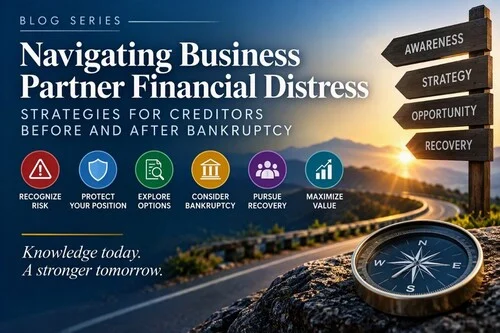
Economic uncertainty can create challenges for even the healthiest businesses. As market conditions shift, companies may find themselves confronting a difficult reality: a customer, vendor, borrower, supplier, or other valued business partner is experiencing financial distress. When that occurs, the questions come quickly. How can a business protect itself? What actions should be taken before a bankruptcy filing? Are there opportunities to improve recovery if bankruptcy becomes unavoidable?
Understanding the options available to creditors during periods of financial distress can make a significant difference in protecting business interests and maximizing potential recoveries. While every situation presents unique facts and legal considerations, proactive planning and strategic decision-making can help creditors navigate uncertainty more effectively.
This eight-part blog series explores key issues businesses should consider when a business partner's financial condition begins to deteriorate. Topics will include:
- Recognizing common warning signs of financial distress and evaluating potential exposure.
- Understanding involuntary bankruptcy and when it may be an appropriate strategic remedy.
- Taking practical steps to protect creditor rights before a bankruptcy filing occurs.
- Examining the fiduciary obligations of directors and officers as companies approach insolvency.
- Identifying potential avenues of recovery beyond the debtor's assets, including claims against management and available insurance coverage.
- Recognizing red flags that may indicate misconduct, self-dealing, fraudulent transfers, or breaches of fiduciary duty.
The reality is that a bankruptcy filing does not always mark the end of a creditor's recovery options. In many cases, meaningful opportunities exist both before and after a business enters bankruptcy. The key is understanding those opportunities early and acting strategically.
In the weeks ahead, Calfee Partner Andy Owen will examine these issues in greater detail and provide practical insights for businesses seeking to protect value, minimize risk, and position themselves for the strongest possible recovery outcomes when dealing with a financially distressed business partner.
Next in the series: Is Your Business Partner Showing Signs of Financial Distress? What Creditors Need to Know.
Read the comprehensive article: “Potential Avenues of Recovery Against an Economically Distressed Business” by Andrew W. Owen, Partner.
Andy Owen is an experienced business litigator who represents clients in the commercial mortgage-backed securities industry and both large and small corporate entities in a wide variety of complex business-related disputes. Andy focuses his commercial mortgage-backed securities litigation practice on the default administration on behalf of corporate trustees and master and special servicers of commercial mortgage-backed securitized trusts. He has significant experience in all aspects of workouts, foreclosures, deeds-in-lieu, bankruptcy proceedings, and receiverships involving multimillion-dollar commercial properties such as hotels, office buildings, shopping centers, and apartments. You can contact Andy via email at aowen@calfee.com or by phone at 614.621.7751.
Calfee, Halter & Griswold LLP is a full-service corporate law firm with 170 attorneys and professionals in Cleveland, Columbus, Cincinnati, and Indianapolis. Calfee serves clients in the Midwest, nationally and globally in the areas of Corporate and Finance, Employee Benefits and Executive Compensation, Energy and Utilities, Estate and Succession Planning and Administration, Government Relations and Legislation, Intellectual Property, Labor and Employment, Litigation, and Real Estate Law. Calfee has been recognized as a leading law firm by Chambers USA 2026 in Antitrust, Banking & Finance, Construction, Corporate/M&A, Employee Benefits & Executive Compensation, Energy & Natural Resources, Environment, Government Relations, Insurance, Intellectual Property, Labor & Employment, Litigation: General Commercial, Litigation: White-Collar Crime & Government Investigations, Public Finance, and Real Estate, and by Chambers HNW 2026 in Private Wealth Law. A founding member of Lex Mundi, Calfee offers international representation through a network of independent law firms with access to 22,000 attorneys located in more than 125 countries. Additional information is available at Calfee.com.
Calfee Connections blogs, vlogs, and other educational content are intended to inform and educate readers about legal developments and are not intended as legal advice for any specific individual or specific situation. Please consult with your attorney regarding any legal questions you may have. With regard to all content including case studies or descriptions, past outcomes do not predict future results. The opinions expressed may not necessarily reflect the viewpoints of all attorneys and professionals of Calfee, Halter & Griswold LLP. Updates related to all government assistance/incentive programs are provided with the most current information made available to Calfee at the time of publication. Clarifications and further guidance may be disseminated by government authorities on an ongoing basis. All information should be reaffirmed prior to the submission of any application and/or program participation.
Subscribe
Recent Posts
- Navigating Business Partner Financial Distress: Is Your Business Partner Showing Signs of Financial Distress? (Part 2 of an 8-Part Series)
- Navigating Business Partner Financial Distress: Strategies for Creditors Before and After Bankruptcy (Part 1 of an 8-Part Series)
- Understanding the Canadian Intellectual Property Office's Patent Term Adjustment (PTA) System
- Rolling Over Without Getting “Rolled” – Points to Consider in Connection with Rollover Equity
- Supreme Court of Ohio Concludes that Mortgage Borrowers Do Not Need to Suffer Actual Harm to Recover Monetary Damages if Lender Fails to Timely Record Mortgage Release
- AI Considerations for Corporate Legal Departments Video Series (Part Seven): How Can Companies Leverage These Emerging Technologies to Improve Legal Operations?
- AI Considerations for Corporate Legal Departments Video Series (Part Six): What Are Companies Doing to Adjust for the Regulatory Landscape in the AI space?
- AI Considerations for Corporate Legal Departments Video Series (Part Five): How Can In-House Legal Counsel Partner With Their Business Units to Support Innovation While Still Addressing Compliance, Ethics and Other Concerns?
- AI Considerations for Corporate Legal Departments Video Series (Part Four): How Are Corporate Legal Departments Balancing Customer Demand and Risk Considerations Related to AI-Enhanced Technologies?
- AI Considerations for Corporate Legal Departments Video Series (Part Three): What Are the Corporate Legal Department Considerations for Policies Related to Implementing Generative AI?
Archives
- October 2026
- August 2026
- March 2026
- February 2026
- October 2025
- September 2025
- August 2025
- July 2025
- June 2025
- November 2024
- October 2024
- August 2024
- July 2024
- December 2023
- November 2023
- July 2023
- June 2023
- April 2023
- March 2023
- February 2023
- January 2023
- November 2022
- September 2022
- August 2022
- May 2022
- April 2022
- February 2022
- January 2022
- November 2021
- October 2021
- July 2021
- May 2021
- April 2021
- March 2021
- February 2021
- January 2021
- December 2020
- November 2020
- October 2020